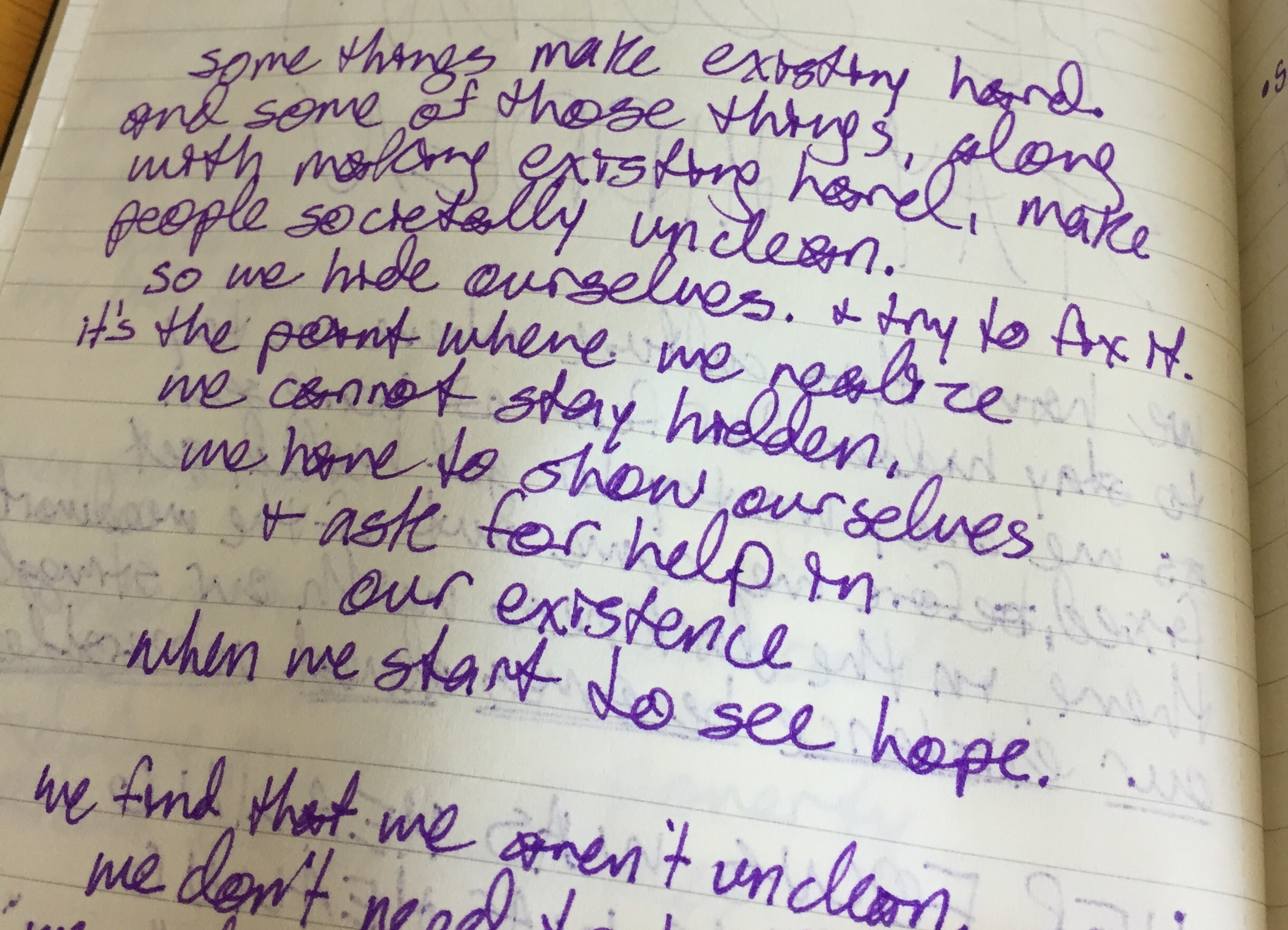
 This post was originally written as a sermon, delivered on November 6, 2016. However, I find more strength in written words and I felt very strongly writing this sermon…so, here it is, in written form.
We underestimate the difficulty of simply existing.
It’s something we take for granted — the ability to traverse each day, to keep moving and breathing and living, to keep pulling ourselves out of bed each morning and to get back to sleep every night. But along the way, there are some things that make existing really, really difficult. Some of us go through crippling anxiety or depression that leaves us paralyzed and unable to move through simple parts of our day. Some of us are plagued by life circumstances, by tragedy, by being constantly overwhelmed by the volume of responsibilities of the day, or by the all-consuming thought that we are living lives we don’t want to live. Others of us have physical conditions that make so many simple tasks seem impossible.
Some of the things that make existence difficult plague us from both ends — they make it hard to go through our daily lives, and they bring us into a harsh place in society due to stigma. In Bible times, stigma was attached to the idea of being unclean, this label that told people they were unfit to go into the presence of God and told their communities that association would make them suffer the same fate.
This is the place where we meet the woman who had suffered bleeding for twelve years (insert comment about THIS WAS A TWELVE YEAR LONG PERIOD, GUYS, IT WAS PROBABLY PRETTY HORRIFYING). She was unnamed, so far removed that she doesn’t even get her own story in the Bible. Not only was she in an awful physical condition, she was declared unclean and cast out from her society. Her existence, a painful and difficult one that probably required her to constantly give all she had, was barely acknowledged. She suffered, and she suffered in a culture that all but condemned her suffering. So, she stayed hidden. Alone. Until she saw Jesus. She figured she could take a chance at being cured while remaining unnoticed — if she could just touch the hem of his robe.
We, from then and into today, have segments of culture that force us into hiding for fear of being seen as we are. We stay hidden, we try to fix ourselves in the dark, try to make ourselves “clean” before we emerge, and it traps us exactly where we are. In those moments before we come out of the woodwork, there in the darkness with our struggles, our existence becomes nearly unbearable.
But there comes a moment — praise God, there comes a moment — when we realize, like the woman in this story, that we cannot stay hidden. We cannot remain in the dark, trapped in a cycle that keeps us where we are. We must show ourselves. We ask for help in making our existence less unbearable. We dare to step out of the darkness and claim to ourselves and those around us that this is not what we want.
Not this life.
Not this loneliness.
Not this darkness.
Not walking this path alone.
We step out into the light. It hurts, but it’s the step. The darkness had kept us blinded to the present hope — as painful as it is to be vulnerable, to show ourselves and risk those moments of judgment, risk being seen as unclean, the light illuminates the hope that things will not be this way forever.
Sometimes, in those first initial, painful steps into the light, we find a higher truth than the darkness can offer us. We find in the light that amid the pain, something better, something more, exists. We find that we are not unclean. We find that we don’t need to be “fixed.” Just loved.
In the light, this woman found that Jesus had no interest in mentioning sins, a past, anything — His focus was healing her of an awful physical condition, healing her of something that made her existence so difficult. She sought help, and she received it. Hope happened.
We, as much as we hate to admit it, need help sometimes — we need help navigating the troubled waters of our existence. We need to not be alone when simply existing is difficult. And that’s okay.
Everybody deserves hope. Everybody deserves the help they need. We are no longer an unclean people. We are not unclean. We are not hopeless. And we are not meant to stay in the dark.
Asking for help, telling your truth, is not, and should not be, a one-way ticket to condemnation or judgment. If you are struggling, if things are hard, do not be afraid to ask for what you need or tell your story. Hear me; the light hurts, but it brings hope. It brings truth. You will find what you need somewhere along the way. Take courage. You are not meant to do this alone.
Show yourself. The world needs to see you. Step into the light, let it illuminate a bigger and more far-reaching truth. Let it illuminate hope. Let it illuminate you.
 the afterthoughts.